


Robotisation does not always deliver the expected results, and it is easy to blame the robot when it fails. In reality, the problems often begin long before the machine reaches the factory floor.
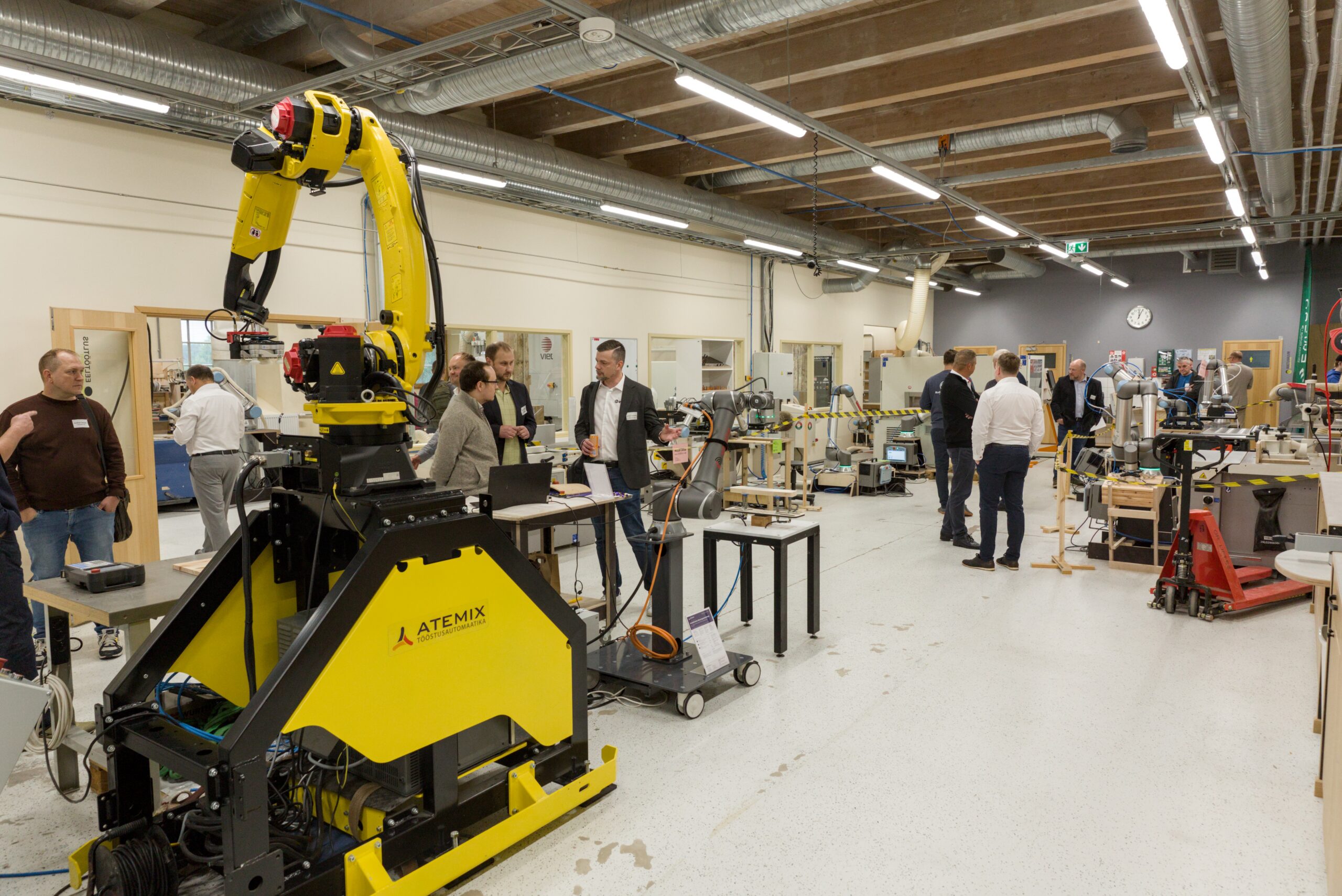
The third Robofest brought together more than 200 visitors from eight countries, with more robots on display at TSENTER than at any previous edition of the event. Yet the central question of the day was not how many robots were present or how technically advanced they were. It was whether companies were truly ready to put them to work.
The discussions at Robofest showed that even state-of-the-art technology will not deliver the desired results if workflows have not been properly thought through, essential details are missing from the project brief, and the company itself has not clearly defined what it wants to change or why. In such cases, a robot will simply reproduce the existing disorder with unwavering consistency.
The first question, therefore, is not which robot to choose, but whether the company understands the work it intends to give the robot. Erkki Naaris, Head of Robotics at TSENTER, summarised it in one sentence:“Look for the task, not the robot.”
A robot cannot fix a bad process
Before making an investment, a company must understand exactly which problem it is trying to solve. If it cannot identify where delays, variations in quality or unnecessary costs occur, even the most advanced technology will not resolve them.
A robot should not be the first step in improving production. The process must first be broken down and examined to determine which activities are genuinely necessary, which could be simplified and which are suitable for automation.
Naaris compared a robot to an employee on their first day at work, someone to whom everything must be explained precisely. An experienced person can often compensate for missing information, adapt their working methods and deal with exceptions independently. A robot follows the instructions it has been given. If the workstation, the movement of materials or the sequence of operations has not been clearly organised, the robot cannot correct those shortcomings on its own.
Preparing for robotisation can still produce valuable results, even if the company ultimately decides not to buy a robot. Giving materials fixed locations, establishing a well-planned sequence of work and eliminating unnecessary activities will also make the process smoother for people. A robot-friendly workplace is usually more comfortable and efficient for human workers as well.
A good solution begins with a good project brief
Experts taking part in the international panel stressed that successful automation projects begin with a clear objective and a thorough understanding of the company’s processes. Technology is a means to an end, not an end in itself. The first priority should be the value that automation is expected to create. Only then should the appropriate technical solution be selected.
The same message emerged from the discussion on preparing specifications for automation projects. The examples presented showed how costly it can become when details that appear self-evident within a company are never communicated to the people designing the solution.
During the development of one welding line, it was discovered only after the equipment had been delivered that the tubes used for lighting columns could not simply meet end to end. For safety reasons, they had to fit inside one another. To the customer, this seemed like standard knowledge. For the machine builder, however, it required a different technical solution, reprogramming, additional expenditure and a delay to the start of production.
Another example involved an automated packaging line whose operation was affected by seasonal changes in the density of flour. This may be considered an ordinary part of everyday work within the company, but when an automated system is being designed, it must be described precisely in the project brief.
These were not primarily technological problems. They were examples of knowledge that had never been documented or communicated. Employees understand the particular characteristics of their products and processes, but often fail to recognise which parts of that knowledge will not be obvious to an external developer.
A good project brief therefore cannot be prepared by a manager, purchasing specialist or systems integrator alone. It must involve the people who will use and maintain the solution, including operators, production managers, maintenance teams and engineers. The earlier the real working conditions, exceptions and limitations are identified, the less likely it is that problems will emerge after the solution has already been built.
A robot does what it is told. If the task has been inadequately defined, even a technically functioning solution may prove inconvenient, expensive or inefficient for the company.
The human role will change, not disappear
Another important question at Robofest was what will remain the responsibility of people in an increasingly automated industrial environment.
Mati Mõttus, Lecturer in Cognitive Computing at Tallinn University, pointed out that machines are faster and more consistent than people and can process larger amounts of information at once. They can also support human memory, attention and perception, while carrying out work that is too physically demanding, repetitive or unpleasant for people.
This does not mean that the human role in production will disappear. According to Mõttus, machines are not yet capable of making the kind of reasoned judgements required to take sound decisions, assess risks, consider ethical questions and account for social norms. Creativity and the ability to improvise also remain distinctly human strengths.
As production systems grow more complex, the ability to see the whole picture becomes increasingly important. A robot or an artificial intelligence system can collect data, monitor a process and support decision-making, but someone must still define the objective, assess the consequences and accept responsibility for the decisions made.
The relationship between people and robots should therefore not be viewed as a confrontation. The question is not only which tasks can be taken away from people, but how the strengths of machines can be used so that people can concentrate on work requiring judgement, experience and flexible thinking.
Ukraine’s experience demonstrates the value of speed
The afternoon programme brought Ukraine’s experience to the stage. Sofiia Shaposhnikova, founder of Lanka Robotics, described how the war has changed the development and use of unmanned systems.
In a crisis, success is not always determined by the most sophisticated technology. The ability to manufacture, test, adapt and deploy solutions quickly can be just as important. A solution that works well enough and reaches the user quickly may be more valuable than a technically perfect system that takes too long to develop.
This idea continued into a panel discussion considering whether war is necessary for industrial development. No single answer emerged, but the discussion highlighted an important distinction. Progress is not driven by conflict itself. It is driven by an urgent need that forces organisations to change established working methods, make decisions more quickly and use existing resources differently.
In peacetime, a company may postpone technological change for years because its existing solution still works. During a crisis, that time may not be available. The ability to decide quickly, work together and accept responsibility becomes critical, even when not all the necessary information is yet available.
Ukraine’s experience does not suggest that crisis should be regarded as a desirable precondition for innovation. Rather, it demonstrates how much faster organisations can act when the need is clear to everyone and the cost of indecision can be felt immediately.
Postponing investment also comes at a cost
The AIRE Club session that concluded the day focused on investment and business competitiveness. Raul Kirsimäe, Head of the Industrial Sector at Swedbank, discussed investment decisions and the risks companies face when they postpone technological change.
The cost of an investment is visible and can be calculated. It is much harder to determine the cost of not investing. Outdated equipment, a high proportion of manual work, slow production and inconsistent quality may not appear as a single, clearly defined expense, but they affect a company’s ability to compete, fulfil orders and recruit employees.
The return on automation should therefore not be assessed solely by how quickly a robot recovers its purchase price. Companies must also consider production capacity, consistent quality, occupational safety, security of supply and the opportunity to use people’s time for tasks where their skills can create greater value.
This does not mean that automation should be pursued at any cost. A poor process does not become a good one simply because it has been robotised. The opposite may happen: the company may begin reproducing its existing shortcomings more quickly and on a larger scale.
There is no truly off-the-shelf solution
Company case studies brought a practical perspective to the discussion.
Wermo’s experience with robotisation showed that even a solution that has worked successfully in another company cannot always be transferred without modification. On paper, the equipment, objectives and production processes may appear very similar. In practice, factors such as batch size, materials, pallet height, variations in component thickness and operators’ working methods can all affect the outcome.
The solution installed at Wermo’s factory required reprogramming, new fixtures and additional adjustments to meet the company’s needs. Development continued even after the line had been installed and formally handed over.
This does not necessarily mean that the original solution was poor. It shows how strongly the outcome of an automation project depends on the day-to-day operations of the particular company in which it is used.
Nerostein’s experience of introducing artificial intelligence highlighted the importance of data quality. AI cannot draw reliable conclusions when the input data is incomplete, inaccurate or described differently across separate systems. Before adopting complex analytics or forecasting tools, a company often has to complete less visible groundwork: organising its data, standardising terminology and deciding which information it actually needs to collect.
This principle connects robotisation and artificial intelligence. In both cases, the results delivered by the technology depend on how thoroughly the company has examined and organised its work before introducing the solution.
Competitiveness is built before the robot arrives
Robofest delivered a clear and practical message. The next leap forward for Estonian industry will not depend solely on new robots or the adoption of artificial intelligence. What will matter is how well companies understand their own work, how precisely they can describe their problems, and how quickly they are prepared to change existing decisions and working practices.
Robotisation means more than purchasing a piece of equipment. It requires processes to be reviewed, employees to be involved, data to be organised and responsibility to be taken.
Sometimes this work may lead to a decision not to buy a robot. That can also be the right decision if the company has already improved the way its production is organised in the process.
Technology creates an opportunity, but it does not determine the outcome. Competitiveness is built through the decisions made before the first robot arrives.
Thank you to everyone who contributed to Robofest!
We would like to thank Robofest moderator Helen Anijalg, as well as all the speakers and panellists who contributed to the event:
Ugnius Gediminas Vygėlis from Industrial Robotics, Daniel Niepsuj from Teradyne Robotics, Thomas Biehl from Nicholaisen, Mati Mõttus from Tallinn University, Ken Varik from ATEMIX, Sander Mitendorf from Smitech, Marko Paavel from Tech Group, Sofiia Shaposhnikova from Lanka Robotics, Andri Haran from the Federation of Estonian Engineering Industry, Tõnu Niilo from Milrem Robotics, Arno Kolk from the Estonian Electronics Industries Association, Marten Merdikes from Auroom Wellness and Raul Kirsimäe from Swedbank.
We would also like to thank the AIRE Centre and all the companies and organisations represented in the EXPO area, who brought their solutions, expertise and people to Robofest.
Our thanks also go to all the supporters and partners whose contribution helped make the event possible: Federation of Estonian Engineering Industry, Demek CNC, Kubija Hotel and Nature Spa, Georgi Hotel, SP Welding, Förmann NT, Võrumaa Toidukeskus, ATEMIX, Tech Group, OMD, EWERS, AIRE, Adapter, Leanest, Marmerk, Retkeke, Võrumaa Development Centre, and Lauri Teppo together with the Kuperjanov Infantry Battalion.
The event has been co-funded by the European Union, see project information.

